
Total: Rs. 0.00
Taxes and shipping calculated at checkout

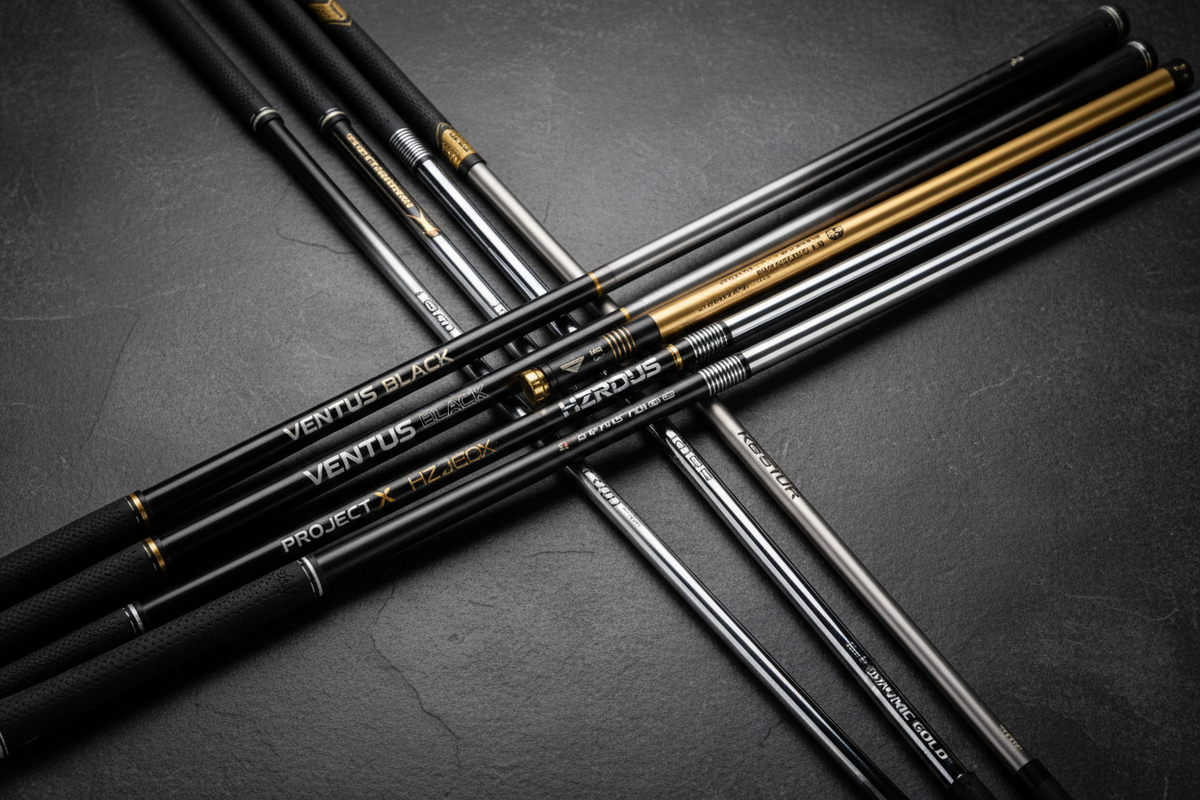
If you've ever walked into a golf shop and been confronted with a wall of shafts labelled L, A, R, S, and X — and had no idea where to start — you're not alone. Shaft flex is one of the most important yet least understood elements of club fitting, and getting it wrong can cost you distance, accuracy, and consistency.
In simple terms, shaft flex refers to how much a golf shaft bends during your swing. This bend — and more importantly, how quickly it snaps back to straight at impact — directly influences the launch angle, spin rate, and direction of your shot. Play with a shaft that's too stiff for your swing and you'll lose distance and hit the ball lower and to the right (for right-handers). Too flexible and the ball will balloon high, spin excessively, and drift left.
Matching shaft flex to your swing speed is one of the highest-ROI improvements any golfer can make — and the good news is it doesn't require buying all-new clubs. In many cases, reshafting or choosing correctly from the start solves the issue entirely.
Knowing your swing speed is the starting point. Here's how to get a reliable number:
| Factor | Regular Flex | Stiff Flex |
|---|---|---|
| Driver swing speed | 75–95 mph | 95–110 mph |
| Typical carry distance | 200–230 yards | 230–260 yards |
| Ball flight | Mid-to-high | Mid-to-low |
| Spin | Higher | Lower |
| Best for | Recreational and mid-handicap | Low handicap and strong hitters |
The driver is where shaft flex has the greatest impact. A shaft that's too stiff will lower launch angle and reduce carry distance significantly. This is especially relevant for beginner and mid-handicap golfers who should almost never use X-Stiff shafts in their driver.
Iron shafts are generally rated slightly firmer than the equivalent driver shaft flex. A golfer playing Regular flex in their driver typically plays Regular or even Senior in irons. Steel iron shafts are generally stiffer than graphite shafts of the same labelled flex.
Most golfers play stiffer wedge shafts regardless of overall flex profile, as it aids control around the green.
If you're a beginner in India buying your first set, graphite shafts in Regular flex are almost always the right starting point.
1. Overestimating swing speed and choosing Stiff when Regular is right — This is the most common mistake. Playing a shaft that's too stiff robs you of distance and makes it harder to square the face at impact.
2. Ignoring flex in irons — Shaft flex in irons meaningfully impacts trajectory and dispersion, especially for mid-handicappers.
3. Assuming all Regular shafts are equal — They're not. A TaylorMade Regular may play stiffer or softer than a Callaway Regular. Always rely on swing speed data rather than the label alone.
If you're spending ₹20,000 or more on a new driver or set, a professional club fitting is absolutely worth it. A fitter will measure your swing speed, attack angle, ball flight, and tempo — and match you to the right shaft weight, flex, kick point, and torque. Many Titleist, TaylorMade, Callaway, and Ping retailers in Indian cities offer fitting sessions ranging from free (with purchase) to ₹1,500–₹3,000 for a standalone session.
Most beginners should start with Regular flex. If you're a senior or have a very smooth, slow swing, Senior (A) flex may be a better fit.
Only if your driver swing speed is consistently above 95 mph. Many mid-handicappers play Stiff shafts for the feel, but Regular flex would give them better distance and consistency.
Graphite is generally better for beginners — it's lighter, generates more swing speed, and dampens vibration on mishits.
Both. The wrong flex causes inconsistent face angle at impact, leading to directional errors in addition to distance loss.
No. There is no industry-wide standard. When in doubt, rely on swing speed data rather than the label alone.


